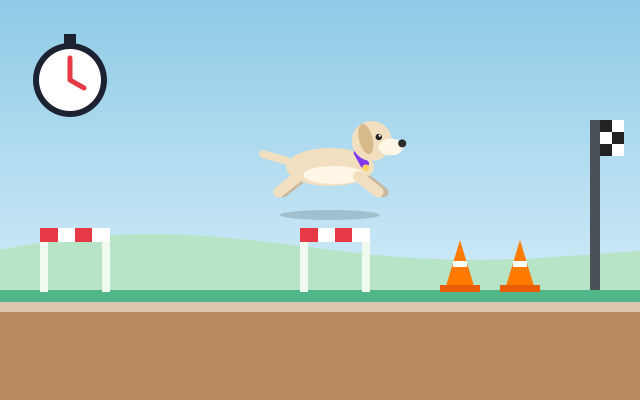
Dog Obstacle Course plays differently from the runners on Dog Arcade, and treating it like one is the most common reason players plateau. It is a fixed-length, side-view agility course. You control the dog's pace with Left and Right, jump with Space or Up, and duck with Down. Hurdles, cones, boxes, puddles, fences and moving obstacles stand in the way.
The crucial difference: hitting an obstacle does not end the run. It counts as a mistake and adds a time penalty. Clearing an obstacle cleanly earns a "perfect" bonus. Your final score comes from your time, your mistakes and your perfects. That scoring changes everything about how the game should be played.
Think like an agility handler, not a runner
In an endless runner, your only goal is not to crash. Here, you will almost certainly finish, so the question is not "will I survive?" but "how cleanly and quickly will I get there?". That shifts the mindset from defence to optimisation.
It also means you have a tool runners lack: pace control. You decide how fast the dog approaches each obstacle. Used well, this is the most powerful control in the game. Used badly, it is the source of most mistakes.
Use pace as your main control
Many players hold the forward direction the whole way and try to solve every obstacle with jump timing alone. That works on simple hurdles and falls apart as soon as obstacles cluster together or start moving.
- Ease off before tricky sections. A brief slowdown before a cluster of obstacles gives you time to read what is coming and set up a clean approach. A small loss of time is cheaper than a penalty.
- Speed up through open stretches. Where the course is clear, there is nothing to gain from caution. Push the pace and bank time.
- Arrive at a consistent speed. Jumps are easiest to judge when you meet each obstacle at a speed you are used to. Wild changes in pace just before take-off make every jump feel different.
A good run has a rhythm of surges and small brakes, not one flat speed.
Match the action to the obstacle
With jump and duck both available, the first skill is choosing the right one for each obstacle. Use an Easy run to go through the course deliberately and note which obstacles you cleared with which action. Keep the notes simple, even just "over" or "under" for each type.
Moving obstacles deserve special attention. Their position when you arrive depends on your pace, which means you can often make them easier by adjusting speed rather than by reacting at the last moment. If a moving obstacle keeps catching you, try arriving a little earlier or later instead of changing your jump.
For general techniques on reading and dodging hazards across different games, our guide on avoiding obstacles has more detail.
Perfects versus speed: finding your balance
Because perfects are a bonus and mistakes are a penalty, every obstacle is worth thinking of as a small swing in score. Clean clear: bonus. Clip it: penalty. The gap between those two outcomes is large, far larger than the few fractions of a second you might save by approaching at full speed.
That suggests an order of priorities for improvement:
- Zero mistakes. First aim to finish without penalties, even if your time is slow.
- More perfects. Then work on making each clearance clean.
- Faster time. Only once the first two are steady, start trimming time in open sections.
Players who reverse this order often end up with fast, messy runs that score worse than slower clean ones. Our guide on getting better scores explains why improving your weakest score component usually pays off most.
Handling a mistake mid-run
Since a mistake does not end the run, what you do next matters. The worst reaction is to rush to "make up time", which tends to produce a second mistake straight away. Instead:
- Accept the penalty. It has already happened.
- Reset your pace to your normal approach speed for the next obstacle.
- Focus on getting the next clearance clean. A perfect right after a mistake recovers some of the loss.
If a run has gone badly wrong early, Restart can be a better use of your time than finishing, especially when you are practising one specific section.
Practise sections, not whole runs
A fixed-length course has a big advantage: you always know there is an end, so every attempt is a complete, measurable run. Use that to practise deliberately.
- Identify your problem obstacle. After a few runs, you will notice that mistakes cluster in the same kind of obstacle or sequence.
- Change one thing. On the next attempt, approach that part at a different pace, or jump a little earlier, and see whether the result changes.
- Move up a difficulty when clean runs feel routine. Each difficulty keeps its own best score in your browser, so moving to Medium or Hard starts a fresh record.
Skills that carry over to other obstacle games
The pacing mindset is unique to Dog Obstacle Course, but other habits transfer well.
Dog Park Dash
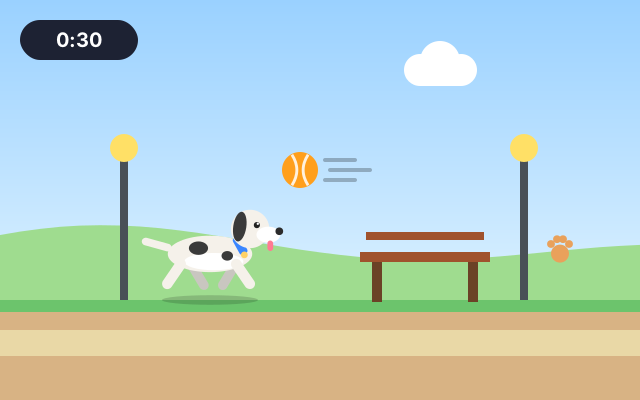
Dog Park Dash also uses jump and duck, with fences, benches and flying balls. There is no pace control, and a timer is topped up by reaching checkpoints. The skill that carries over is choosing the right action early instead of guessing at the last moment.
Dog Race
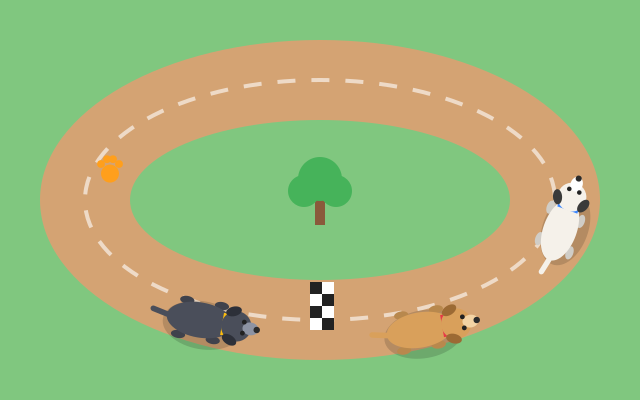
Dog Race is a top-down racer, but it shares the idea that slowing briefly can be faster overall. There, the Down key slows the dog, and using it before a tight section can save more time than crashing through it. Our dog racing game strategies guide covers that in depth.
All of these games sit together in the dog obstacle games category.
Frequently asked questions
Does hitting an obstacle end my run in Dog Obstacle Course?
No. It counts as a mistake and adds a time penalty, and you carry on to the finish. Clean clears earn a perfect bonus instead.
Is it better to go fast or go clean?
Clean first. The swing between a penalty and a perfect bonus is usually bigger than the time you save by rushing, so trim time only once your clearances are reliable.
What does holding back with the Left key do?
It lets you control the dog's pace. Slowing slightly before a cluster of obstacles gives you time to read them and set up a cleaner approach.
Spotted something that doesn't match the game? Tell us through the contact page. Read how we write and check guides in our editorial policy.