Most runs in arcade games end the same way: something was in the way, and you did not get past it. Obstacles are the core challenge in a huge range of games, from side-scrolling runners to top-down yards and mazes. Getting better at them is less about lightning reflexes and more about where you look, how early you decide, and how calmly you recover.
This guide gathers practical, game-agnostic habits for avoiding obstacles, then shows how they apply in specific Dog Arcade games. For the fine detail of jump timing itself, pair it with our guide on timing jumps.
See it early, decide early
Look ahead, not at your dog
The single most useful habit is moving your eyes away from your character. Your dog is always in roughly the same place on screen in a runner; the information you need is coming from the right-hand side. If you watch the dog, obstacles appear late. If you watch the space ahead, they appear early.
- In side-scrollers, keep your focus about a third of the way in from the right edge.
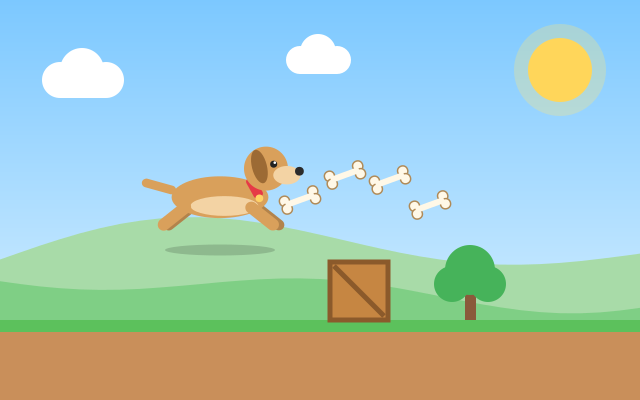
- In vertical games like Puppy Jump, watch the platforms above rather than the puppy.
- In top-down games, look at where you are going next, not where you are.
As the speed rises, shift your gaze a little further ahead to buy back the time you are losing.
Decide early, act on time
There are two separate moments with every obstacle: the moment you decide what to do, and the moment you do it. Many mistakes happen because both are squeezed into the last instant.
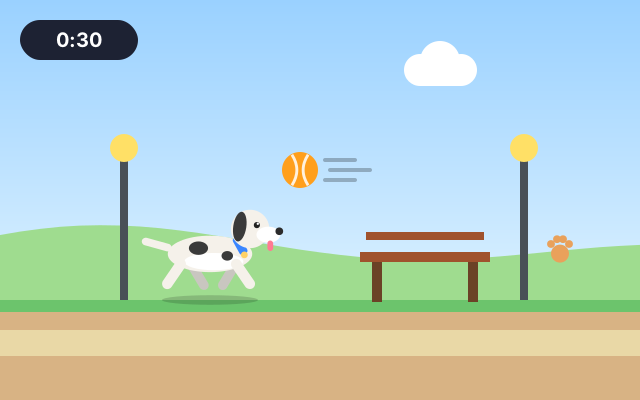
In Dog Park Dash, for example, you jump fences and benches and duck under flying balls. If you identify each obstacle as soon as it appears ("fence, jump" or "ball, duck"), you only need to handle the timing when it arrives. Deciding late makes it far more likely you jump into a ball or duck into a bench.
Learn the obstacle vocabulary
Each game has a small set of obstacles that behave consistently. Learn them once and you can react to shapes rather than thinking each time.
| Game | Obstacles | Typical answer |
|---|---|---|
| Dog Runner | Hydrants, crates, logs | Jump |
| Dog Park Dash | Fences, benches, flying balls | Jump the ground obstacles, duck the balls |
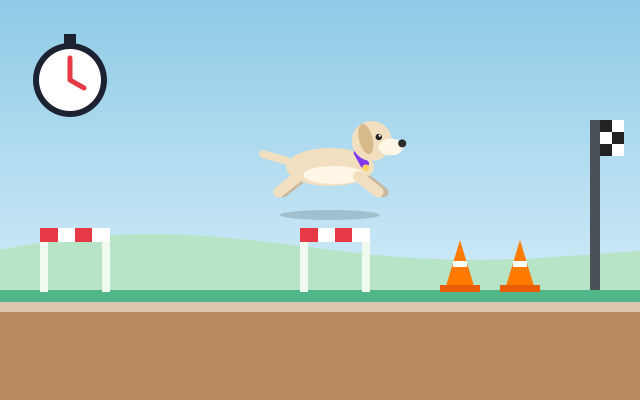
| Dog Obstacle Course | Hurdles, cones, boxes, puddles, fences, moving obstacles | Jump, duck, or adjust your pace |
| Puppy Adventure | Spikes, thorns, gaps, walking critters | Jump over or time your crossing |
| Bone Collector | Bushes, slowing puddles, sprinklers, bees | Route around them |
Use pace, not just jumps
Some games let you control speed, and that is a powerful obstacle tool. In Dog Obstacle Course, Left and Right set your pace. Easing off before a moving obstacle lets you arrive at a moment when the path is clear, instead of trying to jump at the worst possible time. Because hits there count as mistakes with a time penalty rather than ending the run, a slightly slower clean clear is often worth more than a rushed collision. Our Dog Obstacle Course tips go deeper.
In Dog Race, Down slows the dog, which can help you thread past an obstacle on a tight corner.
Moving hazards: watch the rhythm
Moving obstacles are easier than they look once you stop reacting to their position and start noticing their pattern.
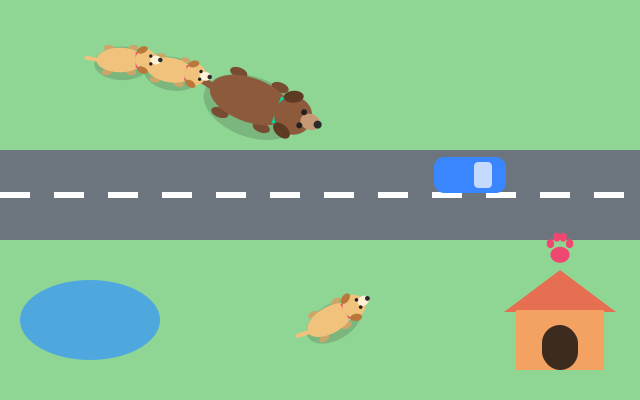
- In Puppy Rescue, moving cars and rolling barrels follow paths. Wait at a safe spot, watch one full cycle, then cross right after a hazard passes rather than just before one arrives.
- In Puppy Adventure, walking critters pace back and forth. Time your jump so you land after they have turned away.
- In Bone Collector, roaming sprinklers and bees move around the yard. Plan your bone route so you pass through their area when they are elsewhere.
Patience is the skill here. A second spent waiting is almost always cheaper than a collision.
Obstacles in top-down and maze games
Not every obstacle is jumped. In top-down games, avoiding hazards is about routes rather than timing.
- Plan the path before you move. In Bone Collector, bushes block your way and puddles slow you down. A route that curves around a puddle is often faster than one that goes straight through it.
- Leave yourself an exit. In Puppy Maze, moving obstacles appear in later mazes. Avoid waiting in a dead end where a moving obstacle can trap you; pause in a junction with more than one way out.
- Plan pushes in advance. In Dog House Escape, a box pushed into a corner may block your route for good. Think one move ahead, and use R to restart the room if you get stuck.
Recovering after a close call
Near misses are dangerous not because of the obstacle you just cleared, but because of the next one. After a close call, most players either freeze or overreact. A few habits help:
- Reset your eyes. Immediately look ahead again instead of replaying the near miss.
- Do not jump early to compensate. A late jump on one obstacle often causes an early jump on the next.
- Breathe out. It sounds simple, but a short exhale helps release the tension that makes the next input clumsy.
Practising obstacles deliberately
Play a few rounds where the only goal is to clear obstacles cleanly, ignoring pickups. In Dog Runner, skip bones that require awkward jumps and see how far pure obstacle play takes you. Then reintroduce pickups once clearing feels automatic. Lower difficulty settings are ideal for this, since they give you more time to see patterns before the speed builds. The guide to improving reaction time offers further drills, and the dog obstacle games category collects the games where these skills matter most.
Frequently asked questions
Should I jump early to be safe?
Usually not. Jumping too soon can bring you down on top of the obstacle. Decide early, but press the key at the right moment.
What is the best way to get past moving hazards?
Watch one full cycle of their movement first, then move right after a hazard has passed rather than trying to beat it.
Do I lose the run when I hit an obstacle in Dog Obstacle Course?
No. A hit counts as a mistake with a time penalty, so you keep going, but it lowers your final score.
Spotted something that doesn't match the game? Tell us through the contact page. Read how we write and check guides in our editorial policy.