Most jumps in arcade games fail for one of two reasons: you left the ground too early, or you left it too late. That sounds obvious, but many players never figure out which of the two they are doing, so they keep adjusting in the wrong direction. Good jump timing is less about reflexes and more about having a clear, repeatable reference point and knowing how to read your own misses.
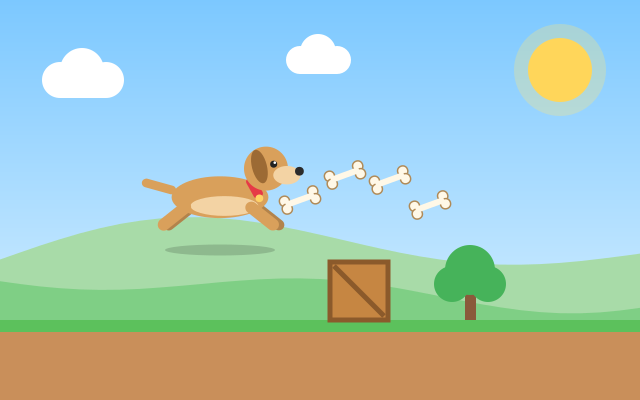
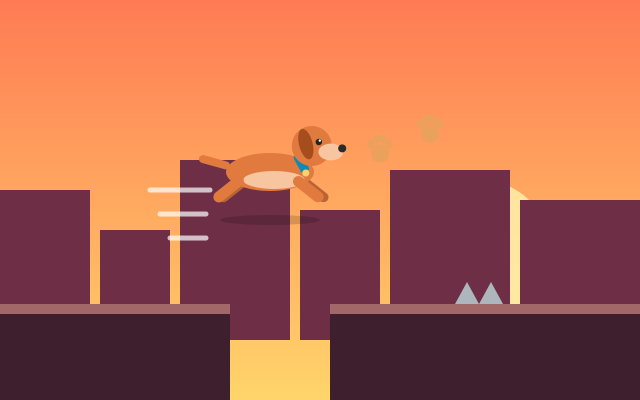
This guide goes deep on the single moment you press jump. The examples use Dog Arcade games such as Dog Runner, Dog Jump Rush, Dog Frisbee Challenge and Puppy Adventure, but the ideas apply to almost any game with a jump button.
Understand the shape of a jump
Every jump has three phases: the rise, the peak and the fall. The dog is highest, and usually moving most slowly upward, at the peak. The most important thing to understand is that you do not need to be at the peak when you pass over an obstacle; you need to be high enough during the whole time the obstacle is underneath you.
For a short obstacle, that window is wide and a jump started a little early or late still clears it. For a wide or tall one, the window shrinks, and the ideal is for the peak to happen roughly above the middle of the obstacle. That means your take-off should come before the obstacle by about half the length of your jump.
Spend one relaxed Easy run in Dog Runner doing nothing but watching the arc. Notice where the dog leaves the ground, where it peaks and where it lands relative to the scrolling obstacles. That mental picture is the foundation for everything else.
Pick a take-off marker
Reacting to "the obstacle is close" is vague. Reacting to "the obstacle has reached that spot" is precise. Choose a fixed visual marker for your take-off:
- A distance in front of the dog, such as "about one dog-length ahead of its nose".
- A point on the screen, such as a feature of the background or a spot relative to the edge of the play area.
Then practise pressing jump when the leading edge of an obstacle touches that marker. Because the dog stays in roughly the same horizontal position in a side-scrolling runner, the marker stays put while obstacles pass through it. This turns timing into a simple visual trigger instead of a gut feeling.
Diagnose early versus late
When a jump fails, look at how it failed:
| What happened | Likely cause | Adjustment |
|---|---|---|
| Dog hit the obstacle while falling | Jumped too early | Move your take-off marker closer to the dog |
| Dog hit the obstacle while rising | Jumped too late | Move your take-off marker further ahead |
| Cleared it but landed on the next one | Jumped too late for the pair, or took an unneeded jump | Treat close pairs as one sequence and plan the landing |
Make one adjustment at a time and keep it for several jumps. Changing your timing after every single miss usually leaves you swinging back and forth between early and late.
Adjust as the speed climbs
In Dog Runner, speed rises over time. This is where many players' timing breaks down, because the jump itself takes the same amount of time but the dog now covers more ground during it. The consequence is precise: as the game speeds up, your take-off marker must move further ahead.
If you keep the same marker all run, you will slowly start jumping late, clipping obstacles on the way up. Watch for that pattern. When your misses shift from falling to rising, the game has outpaced your marker. Nudge it forward.
A good habit is to check your marker after each noticeable speed change, rather than waiting for a crash to remind you.
Press cleanly and consistently
Timing is only as good as your input. A few details help:
- Use one input. Dog Runner accepts Space, Arrow Up, W, click or tap. Each feels slightly different under the finger. Choosing one and sticking with it gives your timing a stable base.
- Keep your finger ready. Hovering just above the key or screen shortens the press. Resting a thumb well away from the screen adds a small, variable delay.
- Tap, do not mash. Rapid repeated presses create unpredictable jumps. One deliberate press per obstacle is easier to correct.
- Reduce lag. Closing heavy background tabs helps the game run smoothly, and a smooth game is easier to time.
Our guide to keyboard controls for browser arcade games covers input setup in more detail.
Timing the double jump
In Dog Jump Rush, a second tap in mid-air triggers a double jump. As in most games with a double jump, when you press the second tap changes what it is good for:
- Tapping near the start of the first jump stacks the two jumps quickly, which is useful for gaining height fast.
- Tapping near the peak extends your time in the air, which helps with long sequences.
- Tapping while falling is a rescue move for a first jump that was started too early.
Because the second tap is also your safety net, deciding when to use it is part of timing. Save it where possible, and use it deliberately rather than as an automatic follow-up.
Timing jumps in other game styles
Jumping to meet something
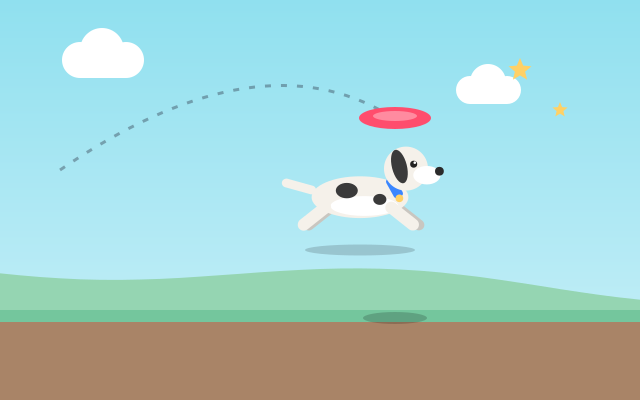
In Dog Frisbee Challenge, you jump to catch frisbees that fly across on arcs, and the score rewards catching at the peak of your jump. Here the reference point is different: you are matching two moving things, your dog's arc and the frisbee's arc.
- Get underneath the catch point first, using Left and Right.
- Watch the frisbee's height as it approaches, rather than its horizontal distance.
- Take off so that your peak lines up with the moment the frisbee arrives at your height.
Players often jump as soon as the frisbee is close horizontally, which puts them past their peak by the time it arrives. Jumping a touch later often produces better catches.
Jumping while you control the run
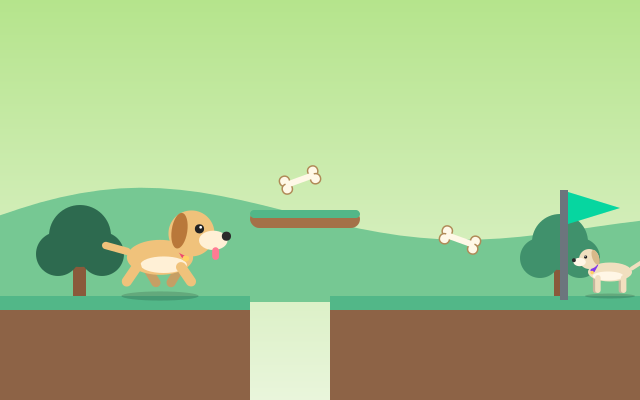
In Puppy Adventure, you control horizontal movement as well as the jump, so your take-off point depends on your running speed. Across gaps, the rule is to commit to a speed before the edge and keep it through the jump. Changing direction mid-approach changes where your arc lands, which is the most common reason for falling short.
For how timing connects to faster responses in general, see improving reaction time in arcade games.
Frequently asked questions
How do I know if I am jumping too early or too late?
Watch the moment of contact. Clipping an obstacle while coming down usually means you left too early; clipping it on the way up usually means you left too late.
Why does my timing get worse later in a Dog Runner run?
The dog covers more ground per jump as the pace rises. If your take-off point stays where it was at the start, you end up jumping late.
When should I use the second tap in Dog Jump Rush?
Keep it as a correction for mistimed first jumps or for longer patterns, rather than tapping twice for every obstacle.
Spotted something that doesn't match the game? Tell us through the contact page. Read how we write and check guides in our editorial policy.