Dog running games look simple: the dog runs, you press a button, things go by. Yet most new players hit the same wall after a few attempts, where runs end at almost the same distance every time. That wall is rarely about fast fingers. It is about where your eyes are, what you decide to ignore, and how well you understand what each game is actually asking of you.
This guide covers the fundamentals that apply to the three running games on Dog Arcade: Dog Runner, Dog Park Dash and Dog Jump Rush. It focuses on reading and decision-making. If you want to go deep on the exact moment to press jump, our guide to timing jumps in arcade games picks up where this one leaves off.
The core loop: the dog runs, you decide
In every running game here the dog moves forward on its own. You never control speed directly. What you control is a small set of actions, and the whole game is about choosing the right one at the right moment:
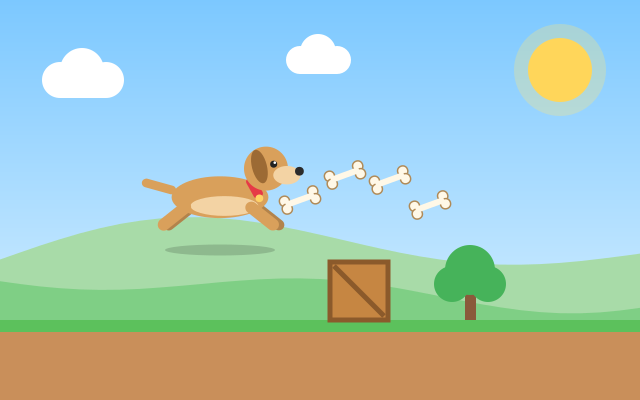
- Dog Runner: one action, jump. Obstacles are hydrants, crates and logs. Bones float along the route.
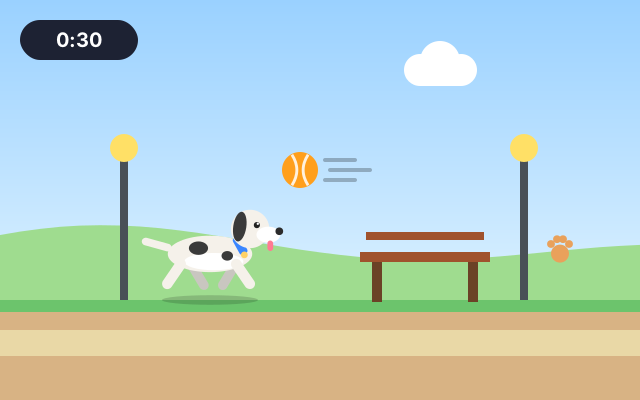
- Dog Park Dash: two actions, jump and duck. Fences and benches must be jumped, flying balls must be ducked under, and a timer ticks down unless you reach checkpoints.
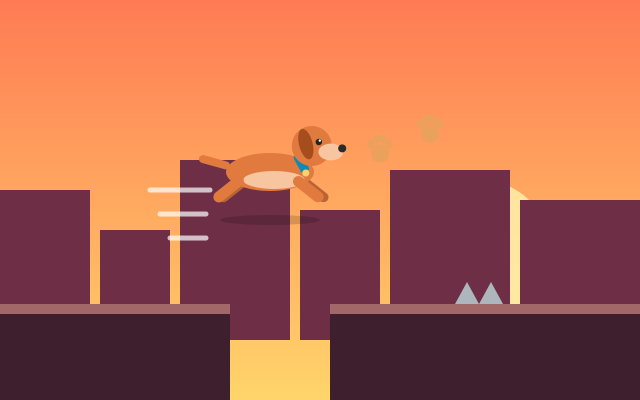
- Dog Jump Rush: one button, but two uses. Tap to jump, tap again in the air to double jump.
Knowing the full list of actions matters because it tells you what kinds of problems the game can throw at you. In Dog Runner, everything on the ground is solved with a jump. In Park Dash, the first question for every object is "over or under?"
Move your eyes forward
The single most useful habit is to stop watching the dog. Beginners tend to stare at their character, which means every obstacle appears in their attention only a moment before it arrives. By then there is no time to decide, only to panic.
Instead, rest your gaze roughly in the middle of the screen or slightly to the right of it, where new objects enter. The dog stays in your peripheral vision, which is enough to know where it is. You are now seeing each obstacle for longer, and that extra time turns reactions into choices.
A practical way to build this habit: on your next few runs on Easy, try to name each obstacle in your head as soon as it appears ("crate", "log", "ball"). If you are naming them late, your eyes are too far left.
Read shapes, not details
You do not need to know that an object is a hydrant rather than a crate. You need to know what it asks you to do. Train yourself to sort objects into simple groups:
- Ground obstacles that need a jump.
- High obstacles such as the flying balls in Park Dash, which need a duck.
- Rewards such as bones and treats, which are optional.
That last word is important. Rewards are never required to keep a run alive. Treating them as optional is the second big mindset shift.
When a bone is worth it and when it is not
In Dog Runner your score is distance plus bones, so bones clearly matter. But a bone that pulls you into a badly timed jump can end the run, and a finished run earns nothing more. A simple rule of thumb:
- If a bone sits along the path of a jump you already need to make, take it. It is free.
- If a bone requires an extra jump in a quiet stretch with no obstacle nearby, take it. The risk is low.
- If a bone requires an extra jump right before or after an obstacle, let it go. The distance you keep is worth more than one pickup.
In Park Dash the calculation shifts slightly, because treats feed combos. Even so, the timer and the checkpoints are what keep the run going. A missed checkpoint costs far more than a broken combo. For a fuller look at weighing rewards against risk, see our guide on getting better scores in arcade games.
How the three running games differ in practice
Dog Runner: learning the rhythm
Dog Runner is rated Easy and it is where the basic rhythm is learned. Early on there is plenty of space between obstacles. As speed rises, gaps that felt generous become tight, and the same jump has to happen earlier. The skill here is adapting smoothly rather than suddenly. If your runs tend to end right as the pace picks up, it usually means your eyes have not moved further ahead to compensate.
Dog Park Dash: managing two clocks
Park Dash asks you to track two things at once: the obstacles in front of you and the timer at the edge of the screen. It helps to glance at the timer only in quiet moments, just after clearing an obstacle, rather than mid-sequence. Checkpoints add time, so the park itself is your source of time; survival and progress are the same goal.
The duck action is the main new skill. A common mistake is ducking too early and then jumping out of the duck into the next obstacle. Treat duck as a short, deliberate press tied to a specific flying ball, not a general safety posture.
Dog Jump Rush: saving your second jump
Jump Rush is the hardest of the three and designed around taps on a phone. The double jump is your safety net, so the key habit is not to spend it automatically. If you tap twice for every obstacle, you have nothing left when a jump goes slightly wrong. Use the single jump by default and keep the second tap for correcting height or clearing a longer pattern.
Build a short practice routine
Running games reward repetition, but mindless repetition teaches less than focused runs. Try a simple three-run routine:
- Run one: eyes only. Play on Easy and focus only on looking ahead. Ignore score.
- Run two: rewards off. Skip every bone or treat that needs an extra action. See how far you get on survival alone.
- Run three: normal play. Combine both, taking rewards only when they are safe.
Comparing runs two and three tells you whether your reward-chasing is helping or hurting. Because Dog Arcade saves a best score per difficulty in your browser, you can move up to Medium once your Easy best starts to feel steady, without losing your earlier record.
Using pause and restart well
Pause (P or Esc) is more useful than it sounds. If you lose focus, pause rather than playing on half-distracted; the run is waiting when you return. Restart is useful in the opposite situation: if a run starts badly and you know it, starting again gets you more practice per minute than pushing through a doomed attempt.
When you want a single clear target instead of an open-ended score, the Daily Dog Challenge sometimes sets survival or jumping goals that use exactly these skills. All three runners live together in the dog running games category.
Frequently asked questions
Can I control how fast the dog runs?
Not in these three games. The dog sets its own pace and the speed climbs as you go; your inputs are limited to jumping, and in Dog Park Dash, ducking.
Why do my runs keep ending at the same point?
Usually because the game has sped up and your attention has not moved further ahead to match. Watching the right side of the screen gives you more time to respond.
Should I always grab bones in Dog Runner?
Only when it is safe. Bones add to your score, but a risky extra jump that ends the run costs you all the distance you would have added.
Spotted something that doesn't match the game? Tell us through the contact page. Read how we write and check guides in our editorial policy.