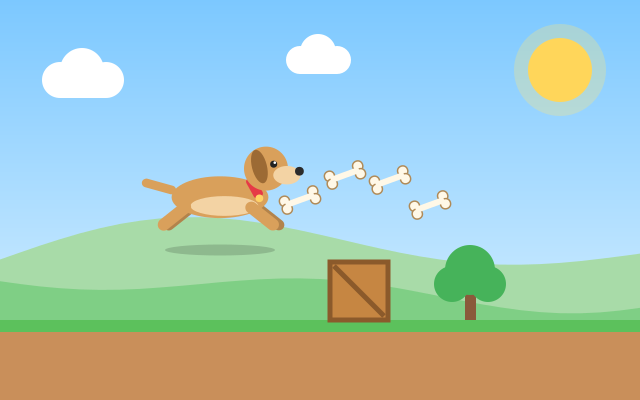
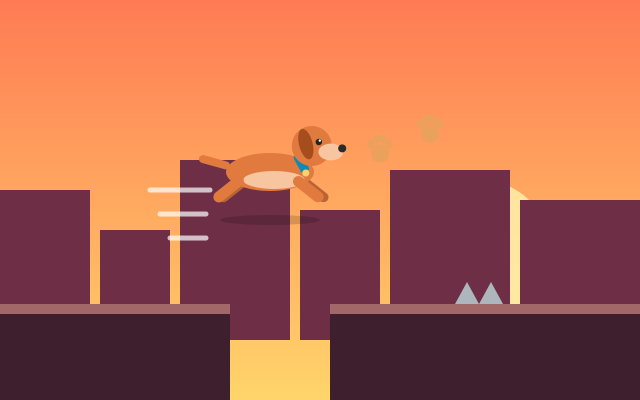
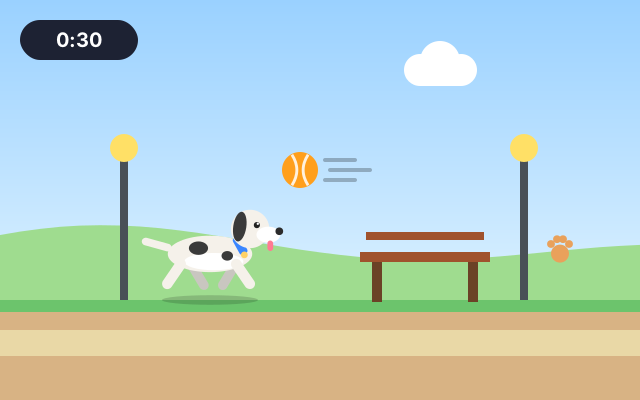
An endless runner has no final level and no fixed map. The world keeps arriving from the right side of the screen for as long as you survive. That raises some natural questions. Where does all that track come from? Why does the game get faster? And if the layout is random, how does it avoid throwing impossible situations at you?
This guide explains the general ideas behind endless runners in plain language, using Dog Runner and Dog Jump Rush as examples of what those ideas feel like from the player's seat. Knowing how the machinery works will not give you secret shortcuts, but it does change how you read a run.
The illusion of movement
In most side-scrolling runners, the dog barely moves across the screen at all. It stays in roughly the same horizontal position while the ground, obstacles and background slide toward it. "Running faster" usually means the world scrolls past more quickly.
Background layers often scroll at different speeds, with distant scenery drifting slowly and the ground moving quickly. That difference creates a sense of depth even in a flat two-dimensional game.
For the player, the practical point is simple: the dog's position is constant, so the only thing changing is how quickly obstacles arrive. That is why the key skill in a runner is reading the space ahead of the dog, not watching the dog itself.
Where the obstacles come from: spawning
An endless game cannot store an endless map, so it builds the world on the fly. This is called spawning: new objects are created just off-screen to the right and removed once they have scrolled past on the left. At any moment, the game only needs to keep track of what is on screen and a little beyond.
There are two broad ways to decide what to spawn next.
Single objects with spacing rules
The simplest approach is to place one obstacle at a time, choosing its type at random and placing it a certain distance after the previous one. The distance itself can vary within a range, which stops the rhythm from feeling mechanical.
Pre-designed patterns
A more controlled approach is to build small hand-made chunks, such as "two low obstacles close together" or "one obstacle followed by a reward", and pick from those. Randomness decides which chunk comes next, but each chunk has been designed to be clearable. Dog Jump Rush describes its challenge in terms of obstacle patterns that get harder, which is the kind of structure this approach produces.
Many games mix the two: patterns for interesting moments, single objects to fill the space in between. Rewards such as the bones in Dog Runner are spawned the same way, often placed in relation to obstacles so that grabbing them involves a small decision.
Why the game keeps getting faster: speed ramps
If an endless runner stayed at the same pace forever, a skilled player could survive indefinitely and the game would lose its tension. So nearly every runner increases difficulty as the run goes on. In Dog Runner, speed rises over time. In Dog Jump Rush, the obstacle patterns grow tougher. In Dog Park Dash, speed increases while a timer keeps pressure on from the other side.
Speed can be ramped in a few ways:
- Smooth ramps increase speed a tiny amount continuously, so you rarely notice a single change, only that the game feels quicker than it did a minute ago.
- Stepped ramps increase speed in noticeable jumps at certain points, which can feel like a new stage beginning.
- Capped ramps stop increasing at some maximum, so the game eventually reaches a top speed and the challenge shifts to pattern density instead.
Speed is not the only dial. Games can also shorten the gaps between obstacles, introduce new obstacle types, or make pattern combinations more demanding. Our guide on how game difficulty progression works looks at these dials more broadly.
The Easy, Medium and Hard settings on Dog Arcade give each game a different overall feel, which is why each difficulty keeps its own best score in your browser.
Keeping randomness fair
Pure randomness is a problem. If obstacles were placed with no rules, sooner or later two would appear so close together that no jump could clear both. Players quickly notice unfair deaths, and the game stops feeling like a test of skill.
Well-made runners use rules to keep randomness honest. Common ones include:
- Minimum gaps. Obstacles must be at least a certain distance apart, and that distance often grows with speed, since a faster dog covers more ground during one jump.
- Reachability checks. Rewards are placed where the character can actually get them.
- Warm-up periods. The first stretch of a run is often gentler, giving you a moment to settle before the pressure starts.
- Readable entry. Obstacles appear far enough to the right that you have time to see them before you need to act.
The ideal is that every death feels like your mistake, not the game's. When a run ends, the question "could I have cleared that?" should almost always have the answer "yes, with a better jump".
Why the score is built the way it is
Endless runners usually tie score to distance because distance directly measures how long you coped with increasing difficulty. Dog Runner adds bones on top, which introduces a second goal. Without collectables, the optimal play would be to jump only when necessary. With them, you are constantly weighing a small reward against a small risk, which keeps quieter stretches interesting.
What this means for how you play
Understanding the machinery suggests a few practical habits:
- Use the early stretch to settle. The start of a run is where the pace is lowest. Find your rhythm there rather than rushing for rewards.
- Expect the ramp. The game will speed up; that is the design. Move your attention further ahead as the pace rises, because obstacles arrive sooner.
- Recognise patterns, not individual objects. If a game uses designed chunks, you will start to see familiar shapes. Recognising "this is the double-obstacle shape" is faster than reading each obstacle one by one.
- Trust that it is clearable. Fair spawning rules mean there is usually an answer. Panicked, early jumps tend to cause more crashes than hesitation does.
For the hands-on side of all this, see how to play dog running games. If you are curious about the technology that lets these games run in a browser tab at all, read how HTML5 browser games work.
Frequently asked questions
Should I try to memorise the obstacle order in Dog Runner?
It is better not to rely on it. Endless runners generally build their track as you play, so reading what is in front of you is a more dependable skill than recalling a fixed sequence.
Why do runners speed up instead of staying at one pace?
A constant pace would let a practised player run forever. Increasing speed or pattern difficulty keeps tension in the run and gives every attempt a natural end.
What makes a random obstacle layout feel fair?
Rules such as minimum gaps between obstacles, a gentle opening stretch, and giving you enough warning to see each hazard before you must react.
Spotted something that doesn't match the game? Tell us through the contact page. Read how we write and check guides in our editorial policy.