Almost every arcade game starts gently and then turns up the heat. The first few seconds of a run feel easy, and a minute later you are reacting as fast as you can. That shift is not an accident: it is designed so that a new player can get going while an experienced player still finds a real test further in.
This guide breaks down the common ways arcade games increase difficulty, shows where each technique appears in Dog Arcade games, and explains how the Easy, Medium and Hard settings relate to the difficulty that builds up inside a single run. Knowing how the ramp works makes it easier to see where your runs are ending and why.
Two kinds of difficulty: settings and progression
It helps to separate two ideas:
- The difficulty setting is chosen before you start. Every Dog Arcade game offers Easy, Medium and Hard, except the Daily Dog Challenge, which uses a fixed setup for the day. The setting decides the starting conditions and how aggressively things change.
- Progression is what happens during a run or across levels. Even on Easy, a game usually becomes harder the longer you survive or the further you go.
Because Best scores are saved separately per difficulty, a score on Hard is never compared with a score on Easy. Each setting is effectively its own track to improve on.
Four ways games raise the challenge
Technique 1: rising speed
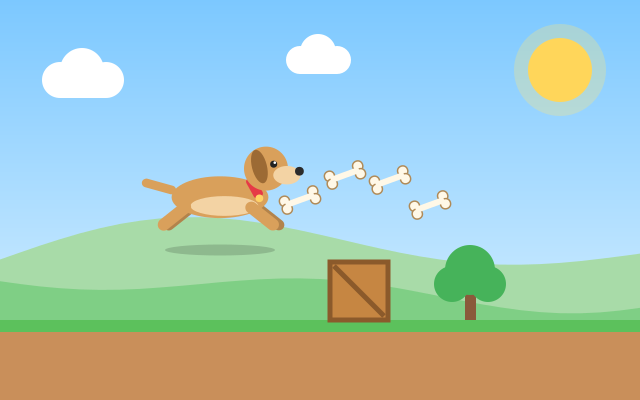
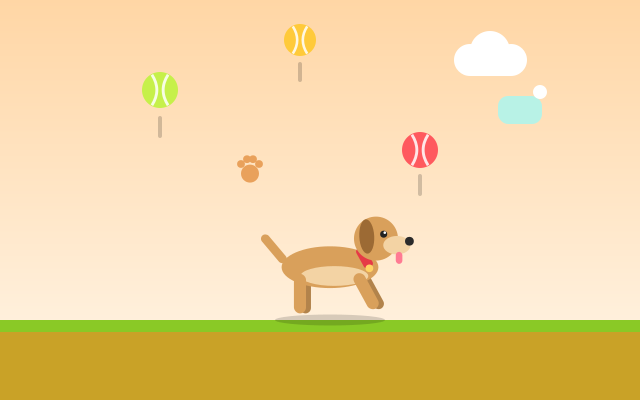
The simplest ramp is speed. In Dog Runner, the dog runs automatically and the speed rises over time, so obstacles that were easy to clear early arrive with less warning later. Dog Park Dash also speeds up as you go, and in Dog Ball Catch items fall faster as the game continues.
Speed is effective because it shrinks your reaction window without changing the rules. You already know what to do; you just have less time to do it. That is why an early mistake in a runner often comes from overconfidence, while a late mistake usually comes from the clock simply getting ahead of you.
Technique 2: denser and trickier patterns
A game can stay the same speed and still get harder by changing what it throws at you. In Dog Jump Rush, obstacle patterns get harder the longer you survive, so a single jump that worked earlier may later need a well-timed double jump. Combinations are what make patterns hard: two obstacles close together, or a gap followed by a hazard, force you to plan more than one move ahead.
For practical ways to handle those patterns, see our guide on avoiding obstacles.
Technique 3: introducing new behaviour
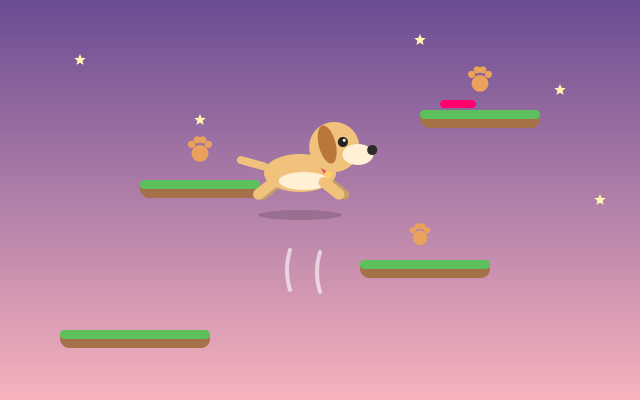
Some games add entirely new elements as you progress. In Puppy Jump, some platforms move or crumble at higher heights, so the safe habit of landing anywhere stops working. In Puppy Maze, moving obstacles appear in later mazes. In Dog House Escape, later rooms ask you to push boxes as well as collect keys.
New behaviour is a gentle way to raise the challenge because it adds something to learn rather than just demanding faster fingers. When you meet a new element for the first time, it is worth playing a little more cautiously until you understand how it moves.
Technique 4: tighter resources
Another lever is how much room for error you get. Timers, lives and penalties all shape difficulty:
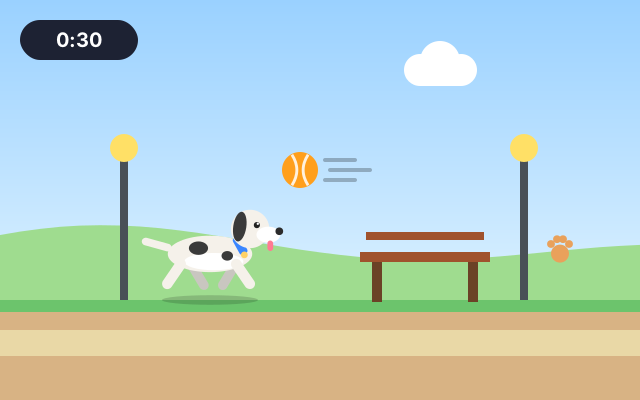
- Timers: Bone Collector gives you a timer and a target number of bones for each level. Dog Park Dash uses a timer that you extend by reaching checkpoints.
- Lives: Dog Ball Catch and Dog Frisbee Challenge use lives, so each mistake brings you closer to the end.
- Penalties instead of failure: Dog Obstacle Course treats a hit as a mistake with a time penalty rather than ending the run, which keeps you playing while still costing you score.
Levels versus endless runs
Progression feels different depending on how a game is structured:
| Structure | Examples | How difficulty builds |
|---|---|---|
| Endless run | Dog Runner, Dog Jump Rush, Puppy Jump | Continuously, the longer you survive |
| Timed rounds | Bone Collector, Dog Park Dash | Through targets, obstacles and the clock |
| Levels | Puppy Adventure, Puppy Rescue, Dog House Escape | Step by step, with new layouts and hazards |
| Fixed course | Dog Obstacle Course, Dog Race | Built into the course; the goal is a cleaner, faster run |
In endless games, the ramp is a curve you ride until it beats you. In level-based games, each level is a step, and you can see exactly where the next step up happens. The guide to endless runner games goes deeper into the first kind.
Why a good ramp feels fair
A well-designed ramp has a few qualities you can notice as a player:
- The early part teaches the core action without punishing you.
- Each increase is small enough that you can adapt.
- When you fail, you can usually point to what went wrong.
- Getting a little further next time feels achievable.
If a game ever feels suddenly impossible, try dropping to a lower setting for a few runs. Easy is not a lesser version of the game; it is the same game with more room to learn the patterns.
Using progression to improve
Understanding the ramp gives you a practical way to track improvement. Instead of only looking at the final score, notice where your runs end. If you always fall around the point where Puppy Jump platforms start crumbling, that is the skill to practice. If Dog Runner catches you only after it speeds up, work on reading obstacles earlier. Our guide to getting better scores has more on turning those observations into progress, and how scoring systems work explains why surviving longer usually multiplies your score.
Frequently asked questions
Does Easy mode ever get hard?
It can. The setting controls the starting conditions, but many games still speed up or add harder patterns during a run, even on Easy.
Why are best scores saved per difficulty?
Because the settings change how the game plays, a Hard score and an Easy score are not comparable. Keeping them separate gives you a fair target on each.
Does the Daily Dog Challenge have difficulty settings?
No. It uses a fixed setup for each day so that everyone faces the same challenge on the same date.
Spotted something that doesn't match the game? Tell us through the contact page. Read how we write and check guides in our editorial policy.